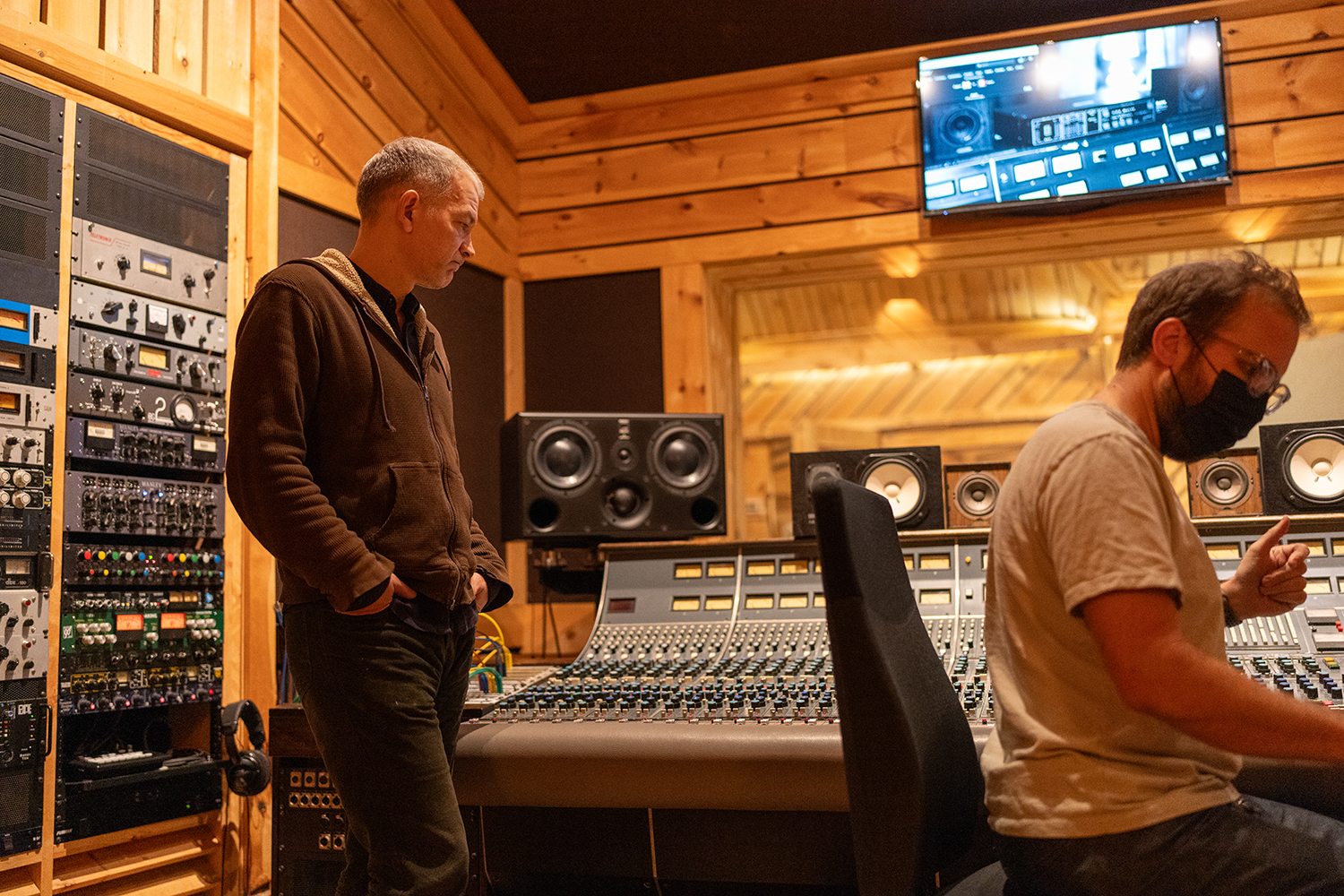
DS: Hey John, Great to see you.
JD: You too Dave, Thanks for doing this.
DS: In terms of Eagle’s Point. What is your role in collaborating with highly skilled musicians, considering their expertise extends beyond traditional production methods? How do you enhance their creative process and contribute to the success of the album in this context?
JD: Well, I think with players like that, the goal is just kind of not to fuck it up, you know, you have to, in the best way possible, make your contribution to the sound and the aesthetic, and then give them room to just do what they do and feel comfortable and keep the vibe good. And I have a lot of history with John (Patitucci) and Brad (Mehldau), and I’ve known Chris (Potter) for a long time, and Brian (Blade), so it was a super comfortable and sort of friendly, fun environment for us.
DS: How do you keep the positive vibes going, especially when a session isn’t going as planned or a musician isn’t at their best?
JD: Yeah, that can be tough. It’s a generational thing. People at that level don’t really play crap solos, and I’m fortunate to be working a lot with people at that level. But sometimes they get vibed out, or they’re not comfortable, or they’re not having a good day. I think it’s about being on the same page with everyone. In addition to being a producer I’ve been a musician for so many years in the scene here, so I feel like I have some understanding and some empathy and I’m able to make people feel better about it, and at the same time being invisible, being efficient enough that when someone’s dealing with their own shit, you’re keeping everything moving smoothly, so that they’re not waiting. Your shit isn’t adding to any frustration.
DS: How do you use your skills to get the most from the studio?
JD: Those are the times when the really fast editing chops kind of shine, because then you can really quickly show someone: look, it’s going to be good. Like, I took half a chorus from this take and half from this tae and it just sounds killing. And then they’re like, Okay, cool. It’s not so bad. But if you’re slow and you can’t edit well, and they’re sitting there for half an hour, and it still doesn’t sound good, then that can really tank the vibe.
DS: What’s your process in creating the right vibe in the studio?
JD: I try to create an environment specific to each album that can foster a specific vibe. So for this album, because that band is so good, I floated the idea to Chris of tracking the whole record on tape, so we couldn’t edit, really, we couldn’t do crazy punches, because there’s no need to and then you get a nicer sound, like you get with film, you know, if you can shoot on film, shoot on film. So yeah, that creates a certain vibe, when all of a sudden guys realise like, oh, cool, we have to go for takes, it raises the stakes a little bit, which is kind of nice.
DS: How do you prepare for a session like Eagle’s Point?
JD: Leading up to it I’m thinking how someone sounds and in that kind of an ensemble, what’s going to be the right kind of sound because a good sound for piano trio is very different from a good piano sound for a quartet and also very different from a good piano sound if there’s a guitar player or multiple horns. So sometimes it’s like, where people are going to go in the studio, which rooms, where’s the piano gonna go, where’s the horn gonna go, where’s the bass gonna go? Is there anything I want to try out to see if it’s cool this time? Because I tend to try stuff. I don’t like having presets like on the drums, putting the same mics on the toms every day. It doesn’t always work out the way you want, but, you know, that kind of pushes you to get better.
DS: What’s your thinking about mic choice & placement?
JD: There’s certain go-tos, you know, I just used a nice old Neumann U47 on Chris, because I know that he always sounds good with a U47. I’m not a fan of using multiple mics on saxophone, although I did use a pair of old Geffel tube omni’s for a bit of room tone. I feel like it gets a little weird and it’s better to just pick one and commit to it, and EQ it a little if you need to, but not have the phase issues of two mics or saving too many decisions for later. It’s maybe a sort of philosophical take where I like to commit to stuff as much as I can early on – which I talk about as being an English thing versus an American thing. And the English engineers always print all their effects, all their compression, all their EQ. And I think usually those records sound better. Talking more in a rock sort of production thing. But yeah, I like that. I’ve always liked that sort of aesthetic.
DS: What about the piano? How, what’s your starting point with the piano in terms of microphone choice, and position.
JD: For piano I like single point stereo mics, like a Neumann SM69, or AKG C24, or something like that. You have a strong centre image and it doesn’t get too hollow. That being said, sometimes a spaced pair with Neumann M49’s can be really nice or 67s or something kind of in between. Not a super wide placement but ORTF, which is 17 centimetres apart or something and angled out a little bit. But again, with a quartet where there’s a little bit more room, a spaced pair is kind of okay, because you can leave some room in the middle for the horn. If the piano hollows out a little bit in the centre that’s not the worst thing. And you’re probably not going to need to collapse it down to one side. It’s kind of okay to let the piano be a little super wide. So I think I used a pair of M49’s for this album, as well as a pair of Royer 121’s on the hammers.
DS: Yeah, and, for example, those first piano chords on Dream of Home. They are so clear with so much clarity of tone.
JD: I mean, one thing that’s astounding, when you work in the same room so much and with the same instrument is how much of it is in the players hands. There’s been times where for whatever reason, there’s multiple players on an album, or you leave a setup overnight from one session to the other and the piano sound is completely different. Not even a little bit different. It’s like, the mics haven’t moved. The piano hasn’t moved, the preamps haven’t been touched – night and day, so it’s, you know… Brad’s got a very, very special sound for sure.
DS: What about drums? Are you going for a simple setup?
JD: I’m micing everything but I’m not necessarily using very much of it. I like to build my drum sound around a mono overhead to start with. The bass drum mic and the mono overhead should give me 80% of what I need,
DS: Why only mono for overhead?
I do have stereo mics as well. But I like to start with the mono thing, just because that’s when you hear a drum set in a room, you don’t really hear it in stereo, really, you hear a drum set where it is, you see it, you hear it. And then you hear the room. And obviously, a recording is such a different thing than hearing anything in a room. You’re trying to create the impression, create the feeling of what a band sounds like in a room; it’s going to be nothing like what a band actually sounds like. But I like to have that strong mono sound, and then use a stereo overhead alongside to kind of support and then spread that out.
I feel a lot of people think of starting with a stereo sound, and then adding a mono thing to kind of give it a centre. Whereas I like to think of it the other way around, where there’s a really strong centre between these two microphones. And then all the close mics or extra overheads or room mics are to create some space and spread that basic sound out left and right. So it still feels natural, and you get some of that nice stereo image. And it’s a fairly wide drum image on this record even though I think I started with having that mono concept to be like, okay, this needs to work.
(mics used: Neumann FET47 on bass drum, SM57 snare top and bottom, AKG 414 (brass capsule) on toms, Neumann KM84 on hihat, Neumann M49 mono overhead, Coles 4038 stereo overheads, Geffel M693 omni pair room mics)
DS: and with Brian’s playing. His playing is so orchestral with so many colours in there…
JD: So dynamic as well. So making sure you’re capturing the details with him is important. Yeah. But also, he sounds so good.
DS: How about someone like Nate Smith, who’s equally as good a drummer, but very different? Would you set that up in a completely different way, and if so, how would you approach that?
JD: I would approach it somewhat differently. But I think that some of the basic things would hold true, you know, that I would still want to have that sort of solid, mono compatible approach, but probably, I would use different close mics if it’s Nate playing beat stuff. The tuning of the drums is going to be different.
DS: When you think about mixing jazz these days, like with a modern record such as Eagle’s Point, how do you see it compared to those old-school Blue Note albums from the 60s? You know, when they’d have drums way over on the left, piano on the right, and sax right in the middle. What’s your take on how jazz mixing has changed since then?
JD: Well, it’s really interesting. I love the way those old records sound a lot but I think that to do it now, and not have it sound like a caricature, is very difficult. Every area of production is building on the previous one whether you like it or not – everything you do is in a post-ECM world, everything you do is in a post-90s Farber impulse world – you can’t pretend they didn’t happen. Some of those Blue Note records have way more reverb than an ECM record, but if you put a lot of reverb on, people are gonna say, oh, you’re trying to make an ECM record. So, I’m trying to take some of the things that I love about that and make it sound the most like what the band in that room sounds like, to me – and I don’t use a lot of reverb these days. I’m not really a big reverb guy, which I think you’ve probably noticed from the last couple things that I’ve delivered. Mark’s (Guiliana’s) record is really dry. Yeah, this record is fairly dry. That seems like the right way to do it. I try to hold on to a little bit of the things that I like about the old records. Maybe that’s part of where my love of the mono drum thing is from – all those old records have one or two mics on the drums. And they sound great, you know, and maybe with a really weird choice of mics, like something underneath the hi hat and the snare drum and another one under the ride cymbal. And that’s it. You know, you see those pictures and it looks insane. Sometimes that’s why the drums sound crazy. But it’s cool.
DS: And those were decisions made back then because of restrictions in technology, essentially, yeah?
JD: Yeah. And wanting to make sure whatever they thought was the important thing to capture and have heard: where we need to hear the right cymbal, we need to hear the snare comping. And then the two and four on the hi hat.
DS: Just because we have the choice of as many inputs as we want, and as many channels as one doesn’t mean, we should go and use them. It’s like, it’s just still got to be about what is the right thing? For the music?
We’re in a very low stakes era with technology. What are the ethical implications of how you record a saxophone? Is it ethical to use seven microphones and six room mics and then hand over a complete nightmare to the engineer? Or this person sounds really good, I’m gonna put one really good mic a couple feet in front of them, the same mic that would have been used on a Blue Note record? That’s ironic too that we’re still using the same mics!
DS: And do the vintage ones sound better than the modern day ones?
JD: Who knows if they sounded like that when they were new? Yeah, it’s kind of weird. Who knows what a brand new 47 sounded like? In 1958? You know, totally different.
DS: Thanks John. Great to chat to you
JD: Thanks Dave
Chris Potter’s Eagle’s Point is out now on Edition Records featuring Brad Mehldau, John Patitucci and Brain Blade.

 Instagram

 Youtube


 Spotify

 Bandcamp

 Apple Music

 Facebook