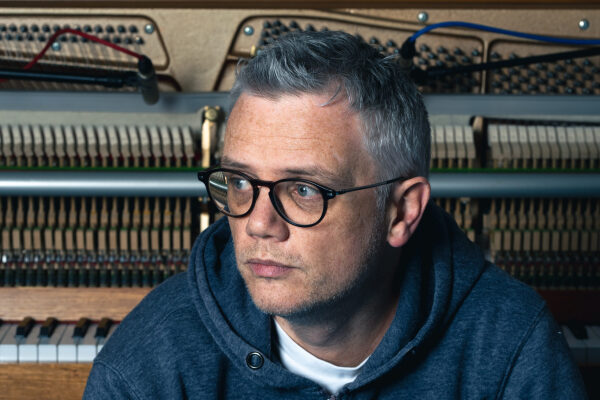
Q&A – Edition Records founder Dave Stapleton on the label’s beginnings, working with artists and the future of independent music.
Dave Stapleton is the founder and CEO of Edition Records, a British independent jazz label established in 2008. Its catalogue brings together artists including Dave Holland, Chris Potter, Gretchen Parlato and Nils Petter Molvær, alongside emerging voices from the UK and Europe.
In this interview, Stapleton reflects on the decisions and relationships that shaped Edition: from its early releases and the breakthrough of Phronesis to working with internationally established artists. He discusses his approach to supporting musicians, building an independent label and finding a sustainable future for creative music.
Q: What did you hope to create when you founded Edition? What was your vision at the time?
A: I don’t think there was really a clear vision of building a business at the beginning. It was more a desire to help release music by friends and musicians I knew. That was as simple as it was. At the time, it was never really about building a business, and I didn’t understand what that would mean.
Q: At what point did you realise that Edition could become a business and grow into what it is today?
A: I think it was about ten years in. We were getting enough traction, we had received our first Mercury Prize nomination and there was a growing weight of artists that enabled us to become greater than the sum of our parts. That was the first real glimpse that we could turn this into a sustainable business.
Multiple revenue streams were also becoming important. Streaming was developing as a source of revenue, vinyl was coming back and it was no longer just about the CD. Social media was becoming more prevalent and the market was changing. That gave newer companies opportunities to reshape what they were doing in ways that some older companies found difficult to keep up with.
Q: Is there a story from Edition’s early days that now feels like a real sliding doors moment?
A: The first one actually happened before Edition: meeting Keith Tippett. Keith was a free-improvising jazz pianist who lived in Bristol. He came to the college where I was studying to teach classical students how to improvise. When I left music college, I set up a small label with a friend. We knew nothing.
About five years later, Keith told me that he had a live recording of his big band from Le Mans Jazz Festival. Somehow, I persuaded him to let us release it on that little label. If I hadn’t done that, or if he hadn’t had the confidence to say yes, I am not sure Edition would ever have started. I probably would have carried on doing my own thing instead. Another moment came when we signed Chris Potter in 2018.
I had just started working with Amy Pearce, a friend who had worked at the London Jazz Festival. She was also friends with Louise Holland, Chris Potter’s manager. When Amy left the festival, I reached out to her with an instinct that I needed to speak to her, without really understanding why or what for. She later became an advisory board member for Edition.
Louise then mentioned to Amy that Chris was looking for a new label. Amy asked whether she had considered Edition. Louise hadn’t. The opportunity could easily have passed us by, and it would never have happened if I hadn’t invited Amy onto the board. One small decision completely changed our direction. Once we signed Chris Potter, many more opportunities with American artists followed.
What makes Edition different
Q: What do you think makes Edition different from other jazz labels?
A: It comes down to the thinking. Structurally, most record labels are similar. They have comparable distribution, they approach the same media and audiences, and they release music in the same formats. What makes labels different is the thinking behind them: how they present the music, talk about it, work with artists and market releases.
That is the brand, and it usually comes from an individual or a small group of people. In our case, it has come from the grind of consistent work and learning over the 22 or 23 years since I started that first little label after music college. All of that experience is relevant because it informed how I started Edition. It has been years of thinking, developing, trying, testing and failing, as well as learning how to understand and work with people.
Musically, it comes back to my taste in sound and in the approaches artists take. Edition sits towards the progressive end. It is about pushing boundaries rather than being comfortable with the status quo. The artists are continually developing their own expression and their desire to say something through the music.
Q: If you had to describe Edition in one word, what would it be?
A: One word is difficult because no single word defines everything. I think about finding natural, lateral solutions to problems. We try to be progressive, bold and clear. There is strong intent in what we do, alongside a desire to be driven by quality, to care and to understand the needs of artists. It is hard to wrap all of that into one word.
Q: How would you describe Edition’s music in one word?
A: Probably progressive, although not in the sense that everything must be extremely experimental or modern. You can be progressive and still make accessible music. Progression can also come from blending genres and ideas. Distinctive might be another word. Perhaps visionary, although those words can sound quite grand.
Q: What does pushing boundaries mean to you now?
A: It means not being comfortable with the ordinary or the status quo. It is about finding something new to say, or a new way of telling the same story. I would like that to apply across the music, how we work with artists, how we market the music and how we operate. Just because something has been done the same way for 30 years doesn’t mean it needs to be done that way for the next 30. Pushing boundaries is like changing the map.
There is never only one kind of map: political, geological and many others can show different boundaries and layers. The deeper thinking comes from recognising that there are different ways to approach artists, ourselves, marketing and music, as well as different ways to look ahead and look back.
Progress and the future
Q: When you look at Edition today, what are you most proud of?
A: I am proud that we made it through the first ten to twelve years of the label and all the challenges that came with them. Financially, that was probably the hardest period. We came through it and built something that can now be genuinely effective. I am also immensely proud that we work with artists who are among the best in the world at what they do. Those are the two things I probably need to reflect on more often.
Q: What is the next step?
A: The next step is to keep evolving as the industry and the wider world evolve. We need to adapt. The goal is to create an environment in which artists can be at their best, and to make the business sustainable enough to allow that purpose to continue.
Q: What do you hope for from this challenging industry?
A: I hope that the politicians and bureaucrats who make rules and regulations have more empathy for the people and small businesses working tirelessly to make things happen. They have considerable control and do not always recognise the effect of their decisions. I hope there can be greater freedom for people to be at their best, without being restricted by things outside their control.
Q: What do you want Edition to represent over the next five or ten years?
A: I want Edition to be an organisation that cares about the music and the people who create it. I want it to be a place that gives artists the environment to do their best work. I want us to find the ideas, collaboration and shared energy that help all of us move forward. Artists can help us through that process too, because it is a two-way relationship. I think the future lies in collaboration becoming a real part of the solution.
Community and artists
Q: You often mention community. What does community mean to you, and what could it mean for the future?
A: Community is a multi-way relationship built around a shared purpose. For us all, that purpose is the music. I feel that we are trying to define a cultural movement around this music in this particular age, and many people care about it.
I don’t want community to be a one-way street from us to the audience. It should flow back to us and between other people – across audiences and the artist community. There should be a sense of togetherness in figuring it all out, and in enjoying and sharing what the music can give us.
Q: Beyond the music itself, what do you look for in an artist?
A: I want to feel inspired by the artist as a human being. They need a quality of their own: a purpose, a vision of what they are trying to achieve and a considered way of conducting themselves. The stronger that is, the more inspiring it is to work with them because they have a clear understanding of their own goals and direction.It should be about what they genuinely want to achieve, rather than ego or trying to outdo another artist. That is when it is most inspiring. The ability to work collaboratively with other people matters too.
Q: Are there any artists or releases that particularly changed Edition’s direction?
A: Alive by Phronesis, Jasper Høiby’s first trio, was significant. At that point, we had released about 15 or 16 albums. I had met Jasper Høiby when he played bass on another record, and he came to me with the idea of recording a live album in London. There was an electrifying chemistry at those gigs.
The combination of the music, Jasper’s leadership, the musicians and the energy from the audience was very special. The album caught people’s imagination and did very well. It was vital in the early part of Edition’s development and opened up many opportunities for us to do different things. There have been many other important releases since then, but that is the clearest early example.
Q: How important is the relationship with an artist to you?
A: It is everything. I want to provide something of value to artists and for them to feel that value. I also want them to feel that they can support what we are doing and be part of the Edition artist community, where people can exchange ideas. It is immensely satisfying when Edition artists meet at a gig or an event and connect because of what we have built. That is motivating and rewarding. It makes you feel that you are building something relevant. In that sense, it is always about the artists.
Lessons and motivation
Q: If you could go back in time and give yourself one piece of advice when you were starting, what would it be?
A: Don’t worry so much. There are always solutions to the problems you face. Act with integrity, do what is right and handle things in the right way. In the long term, things tend to be okay, so don’t worry quite so much.
Q: What would you love fans to know or feel when they encounter Edition and its music?
A: I want them to feel the care that has gone into the whole package and its presentation. A great deal of work happens that many people never see. From the artist’s point of view, I would like fans to appreciate the energy and perseverance required to make music: the challenge of writing, fighting your own mind, and continuing until the music says what you want it to say.
There is so much time and thought in that process. A release is not simply a piece of plastic, a vinyl record or the code that delivers a digital file. Those are only the devices through which the music reaches people. Behind them are conversations, good and bad days, and years spent learning how to write and play at a level the artist is satisfied with.
So much goes unseen. That needs to be recognised, especially when AI can generate music in seconds from a short prompt. The contrast is extreme. It reminds us how difficult writing and releasing music really is, and why we should stop and appreciate the time, energy and human input behind it.
Q: What do you love most about what you do?
A: I love the freedom to make my own decisions. Being a proactive person, I really value being able to shape my own direction. I am very fortunate to have that freedom. I can come into my office or wake up in the morning and know that I can choose what to do that day. Nobody is telling me what I must do. I choose to work on this music and with these people.
Photo Credit: Edition Records

 Instagram

 Youtube


 Spotify

 Bandcamp

 Apple Music

 Facebook