The Edition Story
How Edition grew from humble beginnings to a label that stands at the forefront of the independent global scene.
Part 1
“It was Christmas 2007, and my mind was absorbed with starting again, taking what I had learnt and trying it out on my own”. Dave Stapleton, founder of Edition Records talks about leaving his first imprint Red Eye Music, a label he co-ran with a singer-songwriter friend based in Cardiff. For five years he “fluffed” his way through the trepidations of starting a new music label for his own music, just as the world was morphing into a digital world. “We started Red Eye in 2003. The world was changing and digital was the new revolution in the music industry and I was green. I knew absolutely nothing about the music industry”.
Despite the ignorance, there was plenty of energy. Dave Stapleton graduated from the then Welsh College of Music (the royal came later) in 2002 with a 2:1 in Classical Piano. During this course Keith Tippett, the late legendary pianist, composer and improvisor taught classical students how to read chord symbols and improvise. These weekly lessons lit a spark In Stapleton and a huge desire to write and create emerged. Petrified of playing hour-long programmes of classical repertoire from memory, the thought of making it up in the moment liberated and empowered him. These 5 years co-running Red Eye were hugely informative but at the same time equally frustrating. “We had very different ways of working, with very different music in different industries. The synergies we had at the beginning, united by sheer ignorance, disappeared once we had established ourselves. By Christmas 2007, I instinctively knew I needed to change and start over. This time, building an exclusive Jazz record label was the primary focus”.
Edition was born in early 2008 with jottings of thoughts and with scribbles of what the vision for Edition could be. “I wrote a wish-list of Artists. It included Alexi Tuomarila, who I had been massively inspired by, compositionally, as well as Nicolas Kummert and Bojan Z to name a few. I clearly remember the evening brainstorming names for the label at Tim Dickeson’s house, who was now my business partner at Edition”. Dave first met Tim, a photographer and Jazz lover, in 2004 at one of his gigs in Cardiff. They instantly became friends. When Dave told Tim he was stopping Red Eye and starting a new record label, Tim jumped at the chance with an offer to put in a modest sum of money and become business partners. It was a natural fit. “Tim was the perfect business partner to have as a startup. He had great energy and enthusiasm with a clear and level head. Together, we worked so hard in establishing ourselves in the UK scene as a serious label and it worked. Very quickly established artists were asking us to release their albums from the likes of Mark Lockheart, Troyka and Martin Speake”.
One of the most important discoveries and signings of that period was Jasper Høiby and his piano trio, Phronesis. He first met Jasper at Pizza Express at Mark Lockheart’s ‘In Deep’ album launch in 2009. “I was seeing Jasper’s name crop up everywhere. He was the man of the moment in the London scene. Everyone wanted him in his band but it was his own band, that was actually taking off. I remember Mark Lockheart suggesting we add Phronesis into the ‘In Deep’ press release, as it was a band that was gaining a lot of attention”.
Little by little, release by release Edition was building a reputation in the UK for its quality, passion and energy. The label had an ability to cut through the noise, an attribute that is even more vital in today’s climate,which spoke to many musicians looking to establish themselves in the scene. With Phronesis, Edition had a calling card to a wider audience and to more Artists. “‘Alive’ was a pivotal release. It exceeded expectations on all fronts and it became such an important album to us. It kickstarted a new wave of interest into what we were doing. New artists including Marius Neset, Daniel Herskedal, Oddarrang, Stan Sulzmann, and Kenny Wheeler all released albums in those first few years”. But, it wasn’t all plain sailing.
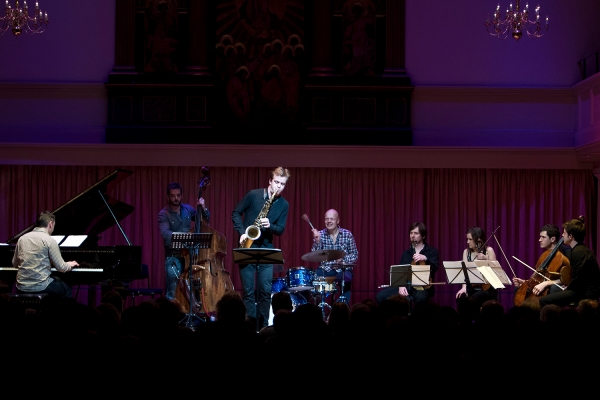
Dave Stapleton performing Flight at St. Georges, Bristol in 2012, with Marius Neset, Olavi Louhivuori, Dave Kane and the Brodowski String Quartet
“The difficult days definitely made the good days more rewarding. And there’ve been quite a few challenging days”. In January 2009, after nine months of trading, New Note, the then classical and Jazz distributor who boasted the ECM catalogue, went into administration. All sales from 2008 vanished. “We literally had to start again, refinance and find new partners”. It was a period of finding the balance between getting everything done, of building the business, whilst at the same time, gigging, pursuing a career as a musician, and starting a young family. “I was constantly tired, working any spare time I had. They were both equally rewarding and difficult days but there were just enough positives that surpassed the negatives to justify continuing”.
The next major shift then came in 2013. “I had a call from Marius Neset, at that time, one of our most important artists alongside Phronesis. We had successfully released two albums, helped him develop a great reputation in Europe and he had just recorded on my own album ‘Flight’, released in 2012. He called me, quite sheepishly, `I’ve had another offer from a label that I can’t refuse, what do you think about it?. What did I think?!, I thought, ‘Fuck’”! It was a wake up call. It felt like a do or die moment and I chose to survive”.
Marius eventually moved on to a new home but this provided an opportunity to kickstart a new phase and a new focus for the business. “It was about throwing in the towel or throwing everything I had into it to see if we can actually make this work in a sustainable way”. This was now 2014, and streaming was starting to get going, albeit with tiny revenues at that time. But it was during this time that deep thinking started to analyse and look at what Edition’s purpose and role played in a modern day music industry, whilst trying to survive in the short term. There were experiments in hiring publicists, in releasing Classical music and in adapting business models. Some of it worked but most of it didn’t. “Throughout 2014 and 2015, we tried so many different ways to make it work. I was now full-time working the business. Tim had retired in early 2014 and so had now very limited resources and people to delegate tasks to. It was an all-encompassing period, with a lot of trial and error and issues to resolve. Growth challenges were very present. As I professionalised the business, the expectations grew. The more I put in, the more people wanted”.
With more and more challenges, Dave reached out to Martin Goldschmidt, the label head of Cooking Vinyl, who had mentored Dave in the early stages of Red Eye Music via an AIM mentorship scheme. This prompted an interest from Martin to discuss becoming a partner with Edition. At this time, he was looking to build a portfolio of labels attached to Cooking Vinyl. “Come back to me with a business plan, and we’ll discuss”. With an armful of projections, budgets and pipeline of releases, Dave returned for a conversation with Martin, this time with his accountant and MD. However, it was immediately apparent the answer was no. Not investable! “It was a painful and fearful time. A carrot had been dangled, a lifeline that I thought could save us but it was taken away as quickly as it was presented”. But rather than dwelling on the negatives, it initiated a new model and a new way of thinking – to simplify everything and get the basics right. “I decided to cut every possible cost except for those things I couldn’t physically do myself. I bought a camera, and taught myself photography. I cut as much of the promotional budgets as I could and we became our own in-house publicist, developing our own networks”. Slowly, release by release, a new energy and momentum emerged that led us towards our 10th birthday. We had some key releases throughout that period, including Dinosaur’s ‘Together As one’, Phronesis ‘Parallax’, Jason Rebello’s ‘Held’ and Tim Garland’s ‘One’. These albums gave us some footholds to leverage more and more traction. By our 10th anniversary, we were starting to create interest in the US”.
Part 2
“I was on holiday in Finland with my family in the summer of 2018. We had taken a trip to an island called Suomenlinna, just south of Helsinki and I had a call planned with Chris Potter’s manager to present our plans”. They were looking for a label for the Circuits band with James Francies and Eric Harland, a project that saw Chris Potter return to groove following three albums on ECM. “I had prepared all my figures and I was clear on what I needed to say but it was a surreal moment. The only phone reception I could get was standing on this rock on the edge of a cliff looking back towards Helsinki. The pitch seemed to go well but really I wasn’t 100% convinced we were going to get it. What I thought was going to be a few days before we would hear turned into weeks and then over a month had gone by. It was an agonising period but it was an opportunity that I knew would step change Edition’s profile. When the call eventually came in, Chris’ manager just said, “I can’t speak for long but it’s yours. We’re so happy”. I couldn’t believe it. The difficult days suddenly seemed to melt away and it all became worthwhile. Here I was, about to release an Artist that I had listened to and studied for a long time. I couldn’t process it but within a month I was in New York watching the band play at the Village Vanguard, this historic Jazz club that I’ve only ever heard about from books and famous albums”.
Releasing Chris Potter’s album was a huge turning point and a signifying moment of what was to follow. Within 18 months a new wave of American Artists took note of Chris Potter’s lead and soon enough Edition was home to the likes of Gretchen Parlato, Nate Smith, Jeff Ballard, Kurt Elling, The Bad Plus, Kneebody, Ben Wendel, Lionel Loueke and Dave Holland. The business was moving from cottage industry to a professional label and it needed help. “It was time to step up the business and build the infrastructure we needed to impact. I was acutely aware that Artists would leave as quickly as they came if I couldn’t impact, so the pressure was on”. In this period Editon moved office from an old second world war barracks with a single-skin brick wall, leaky roof and no heating to a converted barn that had previously housed US soldiers as they prepared for D-Day in 1944 (their signatures are still clearly displayed on the walls behind a glass wall). Dave negotiated a new deal with The Orchard, their distributor since 2012, for global digital rights and physical rights in Europe and North America and built their new website and store which launched in July 2020. It was all part of this larger strategy to stay ahead. “As the world changed, I could see very clearly that selling and communicating directly was going to be very important, and this was before the pandemic hit. Streaming and Vinyl were growing and becoming very important to our business and the whole industry. At that time it was about optimising everything we were doing that supported long term growth but also ensuring the campaigns ran as effectively as they could. I too wanted to re-evaluate what purpose a modern Jazz label had for us and for the Artists”.
Part of that was the aesthetic and visual identity. Artwork in Jazz has been historically important. Impulse, Blue Note and ECM have all developed strong identities and personalities that have stood the test of time. Edition is no different but it has a twist. “I never wanted Edition to be the dominant identifier of an album cover. These albums are the work of the Artists – it’s their vision and their story so I wanted our covers to be Artist driven yet somehow connect them together to become a whole. We’re there to enhance not invade”. For the first 10 years of Edition history, the covers were developed by different freelancers and in the early days, Dave himself. But in 2018, in time for their 10th birthday, Dave partnered with Oli Bentley from Split Design, a decision that saw the coherency and creativity of the visual language excel. “I had seen Oli’s work on and off over the years and to celebrate our 10th birthday we wanted to refresh our identity and artwork. I approached him and immediately there was common ground and spark. I knew I could just trust him to deliver, even if my personal taste said otherwise. He was the Artist and I needed to trust him. Over the 80+ albums we’ve worked on now, I can get less and less involved, he knows what we do, what we want to say and I know what he can do and it just works. He’s an Artist, a thinker and an extraordinary designer. We’ve spoken so much about identity, about brand and how we visualise the Artist’s vision that doesn’t interfere yet still looks like an Edition release. There’s a reason why our logo on our front cover hangs off the side not sat in the centre”.
As a label with a musician at its head, Edition has always understood and had empathy for the Artist. There are huge challenges that each and every Artist faces from the creation, financing, and marketing and it’s more complicated now than ever before. Dave understood this. “For those Artists who had started their careers pre-digital it was incredibly hard for them to pivot and shift focus to understand these new models. Streaming was so alien to them and Social Media took the meaning of self-promotion to a whole new level. For new artists, they were faced with the Herculean effort to get any foothold they could to make a mark. Artists are now required to be a jack-of-all-trades as well as a master of their instrument. We understood this and tried to help where we could, but it’s not just about fighting for editorial space. As an industry, we’re competing for attention with all the distractions of modern life; People are quicker than ever to make judgement from a 10 sec audio clip; Attention spans are now so small we’re barely conscious of what’s happening at all. To us, the answer is about telling a story and finding a narrative that could engage audiences long enough to commit to something more than just following or liking posts”.
There are certain moments in a journey that become pivotal and game changing in a business’ development. More often than not, that importance is not clear at the time, and it’s only in hindsight is it possible to see the relevance and actually how small the margins are between success and failure. “It can be a phrase from someone that sparks a new thought process or an introduction from a contact that can open up an entire new network. I often think to myself, what if I didn’t hear that or if I hadn’t met that particular person. There have been countless moments like this where a small shift or timing in something would have resulted in a completely different outcome. If I hadn’t met Wulf Muller, the legendary A & R exec, I’m not sure we would’ve signed Jeff Ballard, Kurt Elling or The Bad Plus who was instrumental in their signings; if Marius Neset hadn’t left Edition, would I have had the made the decision go full-time, or if Martin Goldscmidt, of Cooking Vinyl, had decided to invest, we would have had the urgency to adapt our model enough to thrive. The most important lesson I’ve learnt is to understand that what appears to be a negative, eventually becomes positive, as long as you change something. Reminding myself of that always gives me confidence in darker days”.
What appears to be a perfectly planned series of strategic events has been then actually something far less romantic, with a similar approach to the very music they are working with. “When a band is improvising, the musicians are all listening to each other, playing from the same chord sheet or road map. When someone plays something, the others will follow and collectively will create a new journey that can’t exactly be repeated. That is what Edition’s journey has been like. It’s a living breathing entity, with only the actions and decisions made that can affect it”.
Part 3
The story of Edition is bound by the relationship between the label and the Artist. All Artists share a quality of intent, a vision, with a drive and commitment to their Art. “That’s what really excites us. There are so many great musicians out there, but it’s less common to find an Artist who has deeply committed to finding their voice and their own sound that’s uniquely theirs. They all share this quality, deeply. No compromises. They’re authentic masters of their instrument and on a lifelong pursuit to create. Our goal is to provide the link and connection between their Art and the audiences, wherever they are and however their listening”.
The music industry has seen seismic shifts in the last decade, especially in the last two years, but the consistent thread throughout everything has been the music and the desire for that music. Ultimately, it’s always been about the connection between the Artists and the Audiences. That link between the two will continously adapt and evolve. “To stay relevant in such a fast paced industry, it’s vital to morph what we do, to the changes that are happening. Nothing ever stands still, and so it either grows or we decline. I love change. It’s always been part of my make-up”.
Edition is now at the centre of change, of redefining how a record label can help Artists reach more and more audiences in a noisy, and complicated world. “We want to challenge convention, how we communicate and present music; how we work with Artists and market the music. We’re committed to challenging what Jazz is by working with the most interesting and progressive Artists on music that challenges, brightens and moves the listener”.

 Instagram

 Youtube


 Spotify

 Bandcamp

 Apple Music

 Facebook